
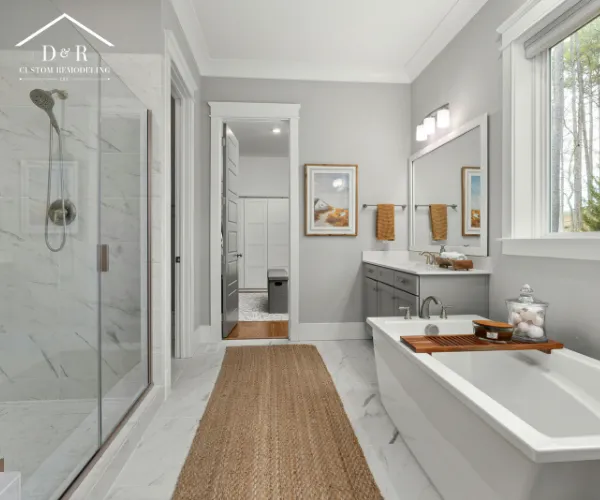
To ensure proper drainage and slope for a curbless bathroom remodeling project, the shower floor must maintain a continuous downward slope of exactly 1/4 inch per linear foot directed toward the drain. This barrier-free layout requires recessing the floor joists or raising the surrounding subfloor to ensure structural framing complies with IPC and IRC plumbing regulations. Implementing a multi-layered waterproofing assembly across the entire wet-room floor prevents moisture tracking, standing water, and structural damage.
Eliminating the traditional shower curb establishes a seamless, open-concept transition that enhances accessibility and spatial design. However, engineering a flawless, zero-threshold entry demands absolute geometric precision and rigorous moisture management. Minor miscalculations in floor elevation can result in subfloor degradation or pooling. This technical guide breaks down the essential engineering principles, subfloor modification workflows, and advanced waterproofing standards required to deliver a high-performing barrier-free space.
The Physics of Curbless Drainage: Understanding Pre-Slope and Sloped Fills
The foundation of any structural wet-room is its slope geometry. According to the International Plumbing Code (IPC), shower subfloors must feature a continuous pitch toward the waste outlet. The standard industry specification mandates a minimum slope of 1/4 inch per linear foot, and a maximum pitch of 1/2 inch per linear foot. If the slope is too shallow, surface tension overcomes gravitational pull, leaving standing water that encourages biofilm growth and damages grout lines. Conversely, if the pitch is too steep, it introduces layout complications for large-format tiles and creates an unstable, non-compliant surface for those with limited mobility.
Geometric Elevation Reference Table
To calculate the required structural drop at the perimeter of your curbless entry, implement the following linear pitch equation:
| Horizontal Distance to Drain (Dlinear) | Required Vertical Recess Depth (Edrop) | Compatible Tile Style & Options |
| 3 Feet (36 inches) | 0.75 Inches | Small mosaics, multi-directional slopes |
| 4 Feet (48 inches) | 1.00 Inch | Small mosaics or envelope-cut larger tiles |
| 5 Feet (60 inches) | 1.25 Inches | Perfect for modern single-plane linear drains |
| 6 Feet (72 inches) | 1.50 Inches | Deep recess; requires heavy joist sistering |
Achieving this uniform fall across a subfloor depends on whether you install a traditional point drain or a modern linear drain. Point drains require a complex, four-way mud bed pitching downward from every corner toward a central hub, restricting tile selections to smaller mosaics to avoid unsightly diagonal “envelope cuts” on large-format tiles.
Conversely, linear drains require only a single-plane, one-way pitch. Placing a sleek channel drain along the wall allows the entire floor to slope uniformly in a single direction. This single-plane engineering enables you to run large-format, slip-resistant porcelain tiles seamlessly from the dry vanity area straight into the wet zone without interruption.
How to Prepare and Modify Subfloors for Zero-Threshold Transitions
The primary engineering challenge of a barrier-free shower is establishing a flush transition by lowering the structural framing beneath the wet zone so the sloped floor meets the adjacent dry subfloor evenly. During structural reviews for residential properties in Austin, TX, and Hutto, we typically implement one of three workflows depending on the architecture:
- Option 1: Recessing Wood Framing: For standard wood-framed subfloors, we cut out the sheathing and sister new, lower-profile dimensional lumber or steel brackets to the sides of existing joists to lower the deck. The modified system must maintain a strict deflection limit of L/360 for ceramic tile or L/720 for natural stone to comply with the IRC and prevent cracking.
- Option 2: Sloped Structural Trays: To optimize efficiency, pre-sloped structural composite trays can replace the traditional plywood subfloor entirely. Sitting directly on recessed ledgers, they provide a perfectly calibrated 1/4-inch pitch out of the box and eliminate mud-bed installation errors.
- Option 3: Concrete Slab Recessing: For homes built on concrete slabs, we mechanically scarify and chip away the top 1.5 to 2 inches of the slab within the shower footprint to embed a sloped mortar bed and linear drain assembly, taking care to protect underlying post-tension cables or rebar.
How to Install Advanced Waterproofing for Full Wet-Room Protection
Without a physical curb, the boundary between wet and dry zones disappears, meaning capillary action, backups, or overspray can easily introduce water to areas designed to stay dry. To safeguard your home, the entire space must be treated as a high-performance wet room by extending advanced waterproofing membranes well past the shower zone.
Step-by-Step Wet-Room Enclosure Strategy
- Subfloor Preparation: Clean the recessed framing or scarified slab entirely to ensure zero debris interferes with membrane adhesion.
- Apply Primary Waterproofing Membrane: Install a continuous, unbonded ANSI A118.10 bonded membrane or an HDPE uncoupling fabric across the entire bathroom floor surface.
- Flash Wall Studs: Extend the membrane layer at least 8 inches up the structural wall studs to create a continuous, watertight tanked basin.
- Seal Seams and Joints: Reinforce every fastener penetration, subfloor seam, and wall-to-floor junction with specialized waterproof banding and vapor-impermeable adhesive sealants.
- Establish a Capillary Break: Install a physical capillary break (like a solid stone threshold or concealed structural L-angle profile) directly beneath the membrane at the threshold transition line. This blocks moisture from traveling horizontally through grout lines and redirects it safely back toward the drain’s weeping system.
Our Proprietary Process: Crafting Perfection Through Integrity
At D & R Custom Remodeling, we believe exceptional architectural design relies entirely on the structural engineering underneath it. Our family-owned business utilizes a refined, multi-step process for executing zero-threshold conversions:
- Expertise and Experience: Our field team brings decades of technical knowledge to safely modify framing, manage fluid dynamics, and protect structural load paths.
- Customized Designs: We avoid generic, one-size-fits-all kits, engineering every slope, framing adjustment, and drain layout to match your home’s unique style and structural constraints.
- Quality Craftsmanship: We deliver quality without compromise by laser-leveling subfloors, verifying exact slope ratios, and conducting mandatory 24-hour flood tests on every membrane.
- Transparent Communication: We replace Austin bathroom remodeling stress with trust by keeping you fully informed with detailed project updates and clear timelines at every stage.
When selecting a trade partner for your bathroom renovation in Austin, choosing a proven expert is vital. We back our work with a comprehensive one-year craftsmanship warranty and direct owner involvement to ensure a level of personal accountability, care, and consistency that larger corporate firms simply cannot match.
Choosing Materials: Balancing Safety, Function, and Style
Beyond structural engineering, the long-term success of your zero-threshold bathroom depends heavily on selecting the right surface materials. Because curbless layouts create a more open environment, choosing slip-resistant flooring is essential for safety. We highly recommend selecting porcelain or natural stone tiles with a Dynamic Coefficient of Friction (DCOF) rating of 0.42 to ensure excellent traction under wet conditions.
During a recent consultation for a high-end bathroom remodeling in Austin, TX, we helped a family select an unpolished porcelain tile that combined a high DCOF rating with a beautiful, natural aesthetic. For point-drain installations, smaller mosaic tiles are ideal because their frequent grout lines naturally increase slip resistance while conforming to multi-directional slopes. If you prefer the clean lines of large-format tiles, pairing them with a linear drain along the wall creates a safe, single-plane floor that functions flawlessly.
Grout selection is equally critical for keeping your wet room pristine and maintenance-free. Traditional cementitious grouts are highly porous, making them susceptible to water absorption, staining, and mold growth. To avoid these issues, we exclusively utilize advanced, non-porous solid epoxy or polyurea-based grouts that are highly resistant to chemical cleaners and entirely waterproof.
People Also Ask (FAQ)
Does a curbless shower require a special drain?
While a traditional point drain works, a linear drain is highly recommended because its single-plane slope simplifies framing and allows seamless installation of large-format tiles without complex diagonal cuts.
How deep does a floor need to be recessed for a curbless entry?
The required depth typically ranges from 1.5 to 2.25 inches. The exact measurement depends on the distance to the drain to accommodate a 1/4-inch per linear foot pitch, plus the tile and waterproofing assembly.
Will water escape into the rest of the bathroom?
When engineered with a precise 1/4-inch slope and a properly sized waste line, water flows directly into the drain. Installing a capillary break beneath the tile transition ensures sub-surface water stays entirely contained.
Can you remodel an existing bathroom to have a curbless shower?
Yes, existing configurations can be beautifully converted. The process involves removing the old subfloor, safely recessing wood joists (or scarifying a concrete slab), adjusting plumbing, and tanking the entire floor.
Ready to Transform Your Bathroom with Confidence?
Don’t leave your structural waterproofing and drainage design to chance. Trust your home to D & R Custom Remodeling, which treats every project with the exact same care, integrity, and attention to detail as if it were our own. Let us replace stress and uncertainty with expert guidance and stunning craftsmanship.
Contact us today to schedule your complimentary professional consultation and take the first step toward building the beautiful, accessible, and high-performance bathroom of your dreams.